1. Why source furniture from Vietnam
Vietnam is now the world's second-largest wood furniture exporter and one of the largest suppliers of wood furniture to the United States, the EU and Japan. For importers rebalancing away from a single-country footprint, Vietnam offers mature logistics (Cát Lái, Cái Mép deep-water ports), competitive labor cost, and factories with a track record of shipping to strict global safety standards.
The country's furniture cluster is concentrated in Bình Dương and Đồng Nai, within 60 km of Ho Chi Minh City. This proximity makes multi-supplier consolidation and same-day factory audits realistic on a single trip.
Vietnam is also covered by an unusually broad network of FTAs and bilateral trade agreements — CPTPP, EVFTA, RCEP, UKVFTA, VJEPA, VKFTA and more — giving Vietnamese-made furniture preferential or duty-free access to virtually every major consumer market. For brands optimizing landed cost across regions, this is a structural advantage a China- or Malaysia-only supply chain cannot replicate.
2. OEM vs ODM: which model fits your brand
OEM (Original Equipment Manufacturing) means you supply the design, drawings, BOM and specifications; the factory engineers for production and manufactures to your standard. This is the right model for established brands with in-house design.
ODM (Original Design Manufacturing) means the factory offers an existing catalog or co-develops new designs with you. It shortens time-to-market for private-label importers, retailers launching a house brand, or DTC startups without a full product team.
Most serious Vietnamese factories — Associate Yang Vietnam Enterprise Co., Ltd. included — run both models in parallel, and can move a customer from ODM sampling into full OEM once volumes justify tooling investment.
3. Global compliance you cannot skip
For nursery and children's furniture, compliance is non-negotiable and enforcement is aggressive across every major market. Programs typically need to satisfy a stack of overlapping regional standards, including:
• United States — ASTM F1169 (full-size cribs), F406 (non-full-size cribs, play yards), F2057 (clothing storage / anti-tip), CPSIA lead and phthalate testing, and CARB Phase 2 / TSCA Title VI panels.
• European Union — EN 716 (cribs), EN 14988 (high chairs), EN 71-3 (migration of certain elements), REACH SVHC restrictions and the EUTR / EUDR due-diligence obligations for timber.
• United Kingdom — BS EN parallels to the EU standards plus UKCA / UKTR requirements post-Brexit.
• Japan / South Korea / Australia — JIS and SG mark, KC safety mark, and AS/NZS ISO 8124 as applicable.
• Third-party accredited laboratory testing (SGS, Bureau Veritas, Intertek, TÜV) with valid product certificates on file for whichever markets you serve.
Ask any prospective factory for redacted historical test reports before your first PO. A supplier that cannot produce them within 48 hours is a supplier that has never shipped a compliant program.
4. Realistic lead times
Sampling: typically 30–45 days from approved drawings, longer if new tooling or custom hardware is required.
Pilot / pre-production run: several weeks after sample approval, depending on complexity, tooling and material availability. We prefer to quote a specific window against your actual BOM rather than a generic number.
Mass production: typically 60–90 days FOB after PO confirmation, extended during Q3 pre-holiday peak. Add 25–35 days ocean transit to US West Coast, 35–45 to East Coast, and 30–40 to major European ports.
5. Factory audit checklist
Before placing a first order, walk (or video-tour) the plant and confirm:
• Ownership and management — is there consistent leadership, or does the site rotate through subcontractors?
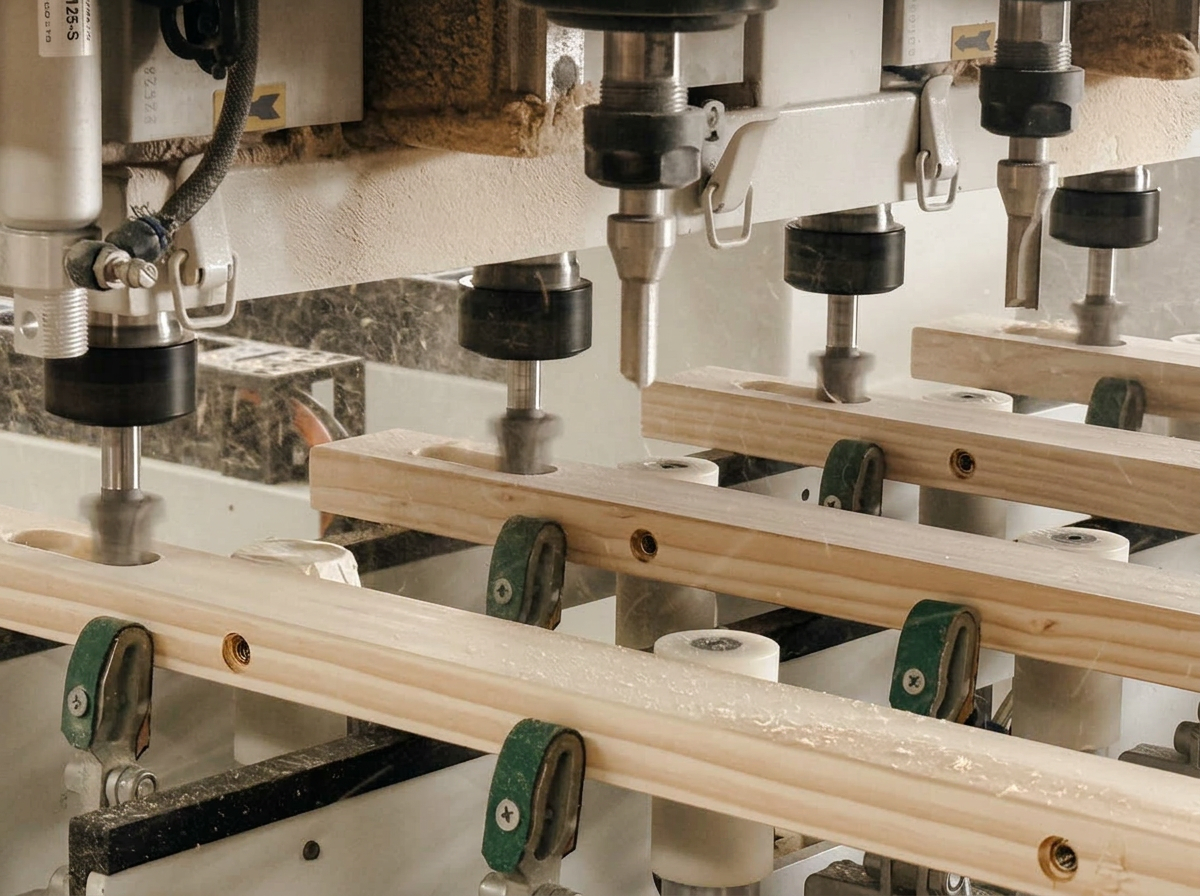
• In-house capability — CNC, edge banding, drilling, sanding, finishing and packing on one campus is a much stronger signal than fragmented workshops.
• Moisture control — kiln-drying capacity and MC meters in use on the floor (target 8–12% for US-bound product).
• Finishing environment — dedicated coating booths, proper respirators (not surgical masks), and low-VOC coating inventory.
• Documentation — documented product specifications, SOPs with clear checkpoints, an AQL-based inspection plan, and a defect classification manual.
• Social compliance — BSCI, Sedex or SMETA audits on file if you sell into major US or EU retail.
• Supply-chain security — US C-TPAT anti-terrorism certification for factories loading US-bound containers.
6. What to send when you request a quote
To get a serious response inside a week, send: (1) product drawings or reference images with dimensions, (2) target FOB price and annual volume, (3) required certifications and target markets, (4) packaging preference (KD flat-pack vs assembled) and (5) preferred shipping window.
If the factory has its own design capability — as we do — a hand sketch, a mood board or a competitor reference photo is enough to hit the same response window. Our R&D team will convert it into a production-ready drawing, BOM and sample proposal without waiting on your side for finished CAD.
Vague RFQs get vague quotes. Specific RFQs — or a clear sketch plus target market — get engineering feedback, honest pricing, and a sample within six weeks.